Pages

Friday, May 8, 2020

Food For Friends Pt.2

photo by Kurt Lacourrege
Thank you for your generous support! The total amount of donation to Second Harvest Food Bank has exceeded one thousand dollars during the first round of Food For Friends campaign and studio sale.

For the second round, I have a list of plein air paintings from the streets of New Orleans, Chalmette Battlefield, Jackson Barracks Military Museum at the edge of Orleans Parish, and the north shore of Lake Pontchartrain. Quite a few pieces from the first round are also still available: Visit this page for your consideration.

Like the first round, 50% of all proceeds go to Second Harvest Food Bank of Greater New Orleans and Acadiana, a non-profit feeding those in need throughout Southern Louisiana. If you have a preferred organization in need of COVID-19 related donations, please let me know and I will donate your portion to them instead. 

Interested? Send me an email at kaorinola@gmail.com with Food For Friends in subject line, and include the number & title of the piece you'd like to purchase, your full name, shipping address, and phone number in the body of your email. Then we will arrange payment method, and pickup/delivery/shipment. I will also send you a proof of donation. 

Local pickup in uptown New Orleans is welcome and delivery is available within the greater New Orleans area. UPDATE: I ask you to chip in 50% of domestic ground shipping if the cost is over $20, and please inquire about expedited or international shipping with extra fee.

Hope to see you all safe and well when this health crisis subsides.

Kaori


#E1 - New Orleans Botanical Gardens (plein air)
12"x16" canvas board
250

#E2 - Staple Goods on St. Roch Ave. (plein air)
12"x16" muslin on flat wood panel
250

#E3 - Mississippi River at the Foot of Canal St. (plein air)
12"x16" canvas board
250

#E4 - Uptown Cemetery: workshop demo (studio)
12"x16" canvas board
250

#E5 - Camp at Harmony, Garden District (plein air)
12"x16" canvas board
250

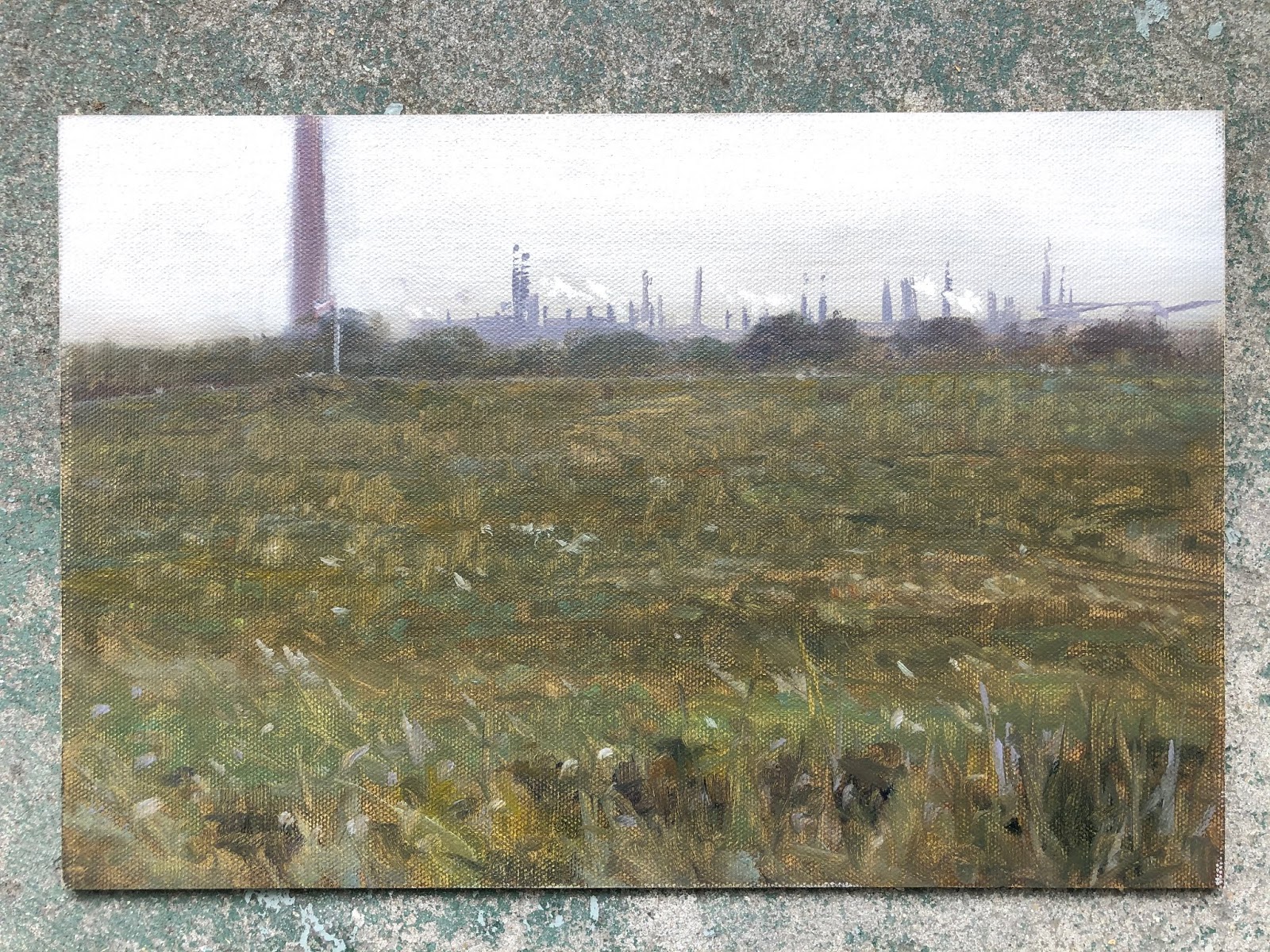
#E6 - Chalmette Battlefield I (plein air)
8"x12" RayMar panel
200

#E7 - Chalmette Battlefield II (plein air)
8"x12" RayMar panel
200

#347 - B26, Jackson Barracks (plein air)
10"x20" stretched canvas
250

#368 - Jeep I, Jackson Barracks (plein air)
10"x20" stretched canvas
250

#369 - Jeep II, Jackson Barracks (plein air)
14"x18" stretched canvas
300

#370 - Jeep III, Jackson Barracks (plein air)
14"x18" stretched canvas
300

#376 - Arabi Water Tower (plein air)
24"x18" stretched canvas
450

#344 - Fontainebleau State Park (plein air)
12"x16" flat wood panel
250

#345 - Freedom study, Madisonville (plein air)
12"x12" flat wood panel
200

#347 - Closed Today, Slidell (plein air)
18"x24" stretched canvas
450


Lagniappe! 
Here are some photos of me painting "Closed Today" in Slidell, LA in April 2018, by Kurt Lacourrege, who happened to drive by and caught me in my natural habitat: by the ditch. Thank you, Kurt!

photo by Kurt Lacourrege

photo by Kurt Lacourrege

photo by Kurt Lacourrege


Thursday, April 9, 2020

Food For Friends

Dear friends,

How are you doing? I hope you're feeling well and all is safe.

Here in New Orleans the situation is not looking great. Luckily I am still healthy and so are my immediate family members. But there are many, many people who are not so lucky, and I want to help, with your help.

It may be difficult for some of you to even think about helping others. With that in mind, below is what I'd like to present: please read on if you're in a position to help.

I have set up a Food For Friends campaign and studio sale here.

50% of all proceeds go to Second Harvest Food Bank of Greater New Orleans and Acadiana, a non-profit with a long history of feeding those in need throughout Southern Louisiana. With the onset of COVID-19 they have expanded their already wide reaching operation to include feeding healthcare workers and first responders, service industry and gig workers (that's me), public school children, and practically anyone who needs to eat. They deliver meals door-to-door to seniors and disabled, and in addition to monetary donations, they're accepting fresh produce and non-perishable food, cleaning/sanitation supplies, and volunteers.

Many of the small oil paintings below were created as experiments (except for one that was made for a group show), and there may be minor irregularities in size and shape. Some have been on my website for a while with higher prices. All are in oil, and come in three different grounds: archival paper, canvas boards, or stretched canvas. Canvas boards I use are considered non-archival, although they will definitely last for our lifetime. All in all, the pieces are priced at minimum for this campaign.

Interested? Send me an email at kaorinola@gmail.com with Food For Friends in subject line. Please include the number & title of the piece you'd like to purchase, your full name, shipping address, and phone number in the body of your email. Then we will arrange payment and pickup/delivery/shipment. I will also send you a proof of donation.

Local pickup in uptown New Orleans is welcome and delivery is available within the greater New Orleans area. Domestic ground shipping is free. Please inquire about expedited or international shipping with extra fee.

If you're in New Orleans area and interested in my larger pieces on my website, please inquire to arrange a private, social-distanced viewing in person. And let me know of your preferred organizations in need of COVID-19 related donations. Unfortunately I cannot ship my larger pieces at this time.

Like many of you, I had to ask my parents to stay home and not go out unless it is absolutely necessary. Since they live in Japan I can not bring groceries to them, and they don't have a coordinated support like the one Second Harvest offers. If you have neighbors who are older or disabled, please check on them and say hello as much as you can. And please take care of yourselves and your community.

Best,

Kaori


oil on archival paper (unframed)

433 - Adams Street Grocery II
14"x10" image, 15"x11" paper
200

432 - Annunciation and Melpomene (plein air)
14"x10" image, 15"x11" paper
200

431 - Tchoupitoulas and Orange (plein air)
10"x14" image, 11"x15" paper
200
413 - Hooly, Inc.: N. Alexander near Conti (plein air)
10.25"x14" image, 11"x15" paper
200

412 - Stop: Conti and N. Olympia (plein air)
10"x14" image, 11"x15" paper
200

417 - Rust IV
13.5"x10" image, 15"x11.25" paper
250

416 - Rust III
13.5"x9.75" image, 15"x11" paper
250
415 - Rust II
12.75"x10" image, 14"x11.25" paper
sold
414 - Rust I
12.75"x10" image, 14"x11.25" paper
250

oil on board (unframed)

377 - Behind the VA: Banks and Rocheblave (plein air)
16"x12" canvas board
250
375 - French Quarter Alleyway: Iberville and Clinton (plein air)
8"x12" muslin on Gatorboard
220

374 - View from Maurepas: Dauphine and Louisa (plein air)
10"x20" canvas board
250
373 - View from the Bomb Factory: N. Robertson and Japonica (plein air)
12"x8" muslin on Gatorboard
sold

372 - Neutral Ground: St. Roch and N. Villere (plein air)
8"x10" muslin on hardboard
sold


oil on 7/8" deep stretched canvas (unframed)

407 - Redemptorist Gym: Josephine near Constance (plein air)
10"x20" stretched canvas
300

406 - Royal at Clouet (plein air)
10"x20" stretched canvas
sold

405 - Laurel at Josephine (plein air)
10"x20" stretched canvas
300

404 - St. Alphonsus (plein air)
18"x14" stretched canvas
sold

403 - Architect Street (plein air)
14"x18" stretched canvas
sold

387 - Didn't See You
12"x9" stretched canvas
200

Saturday, November 23, 2019

Rust

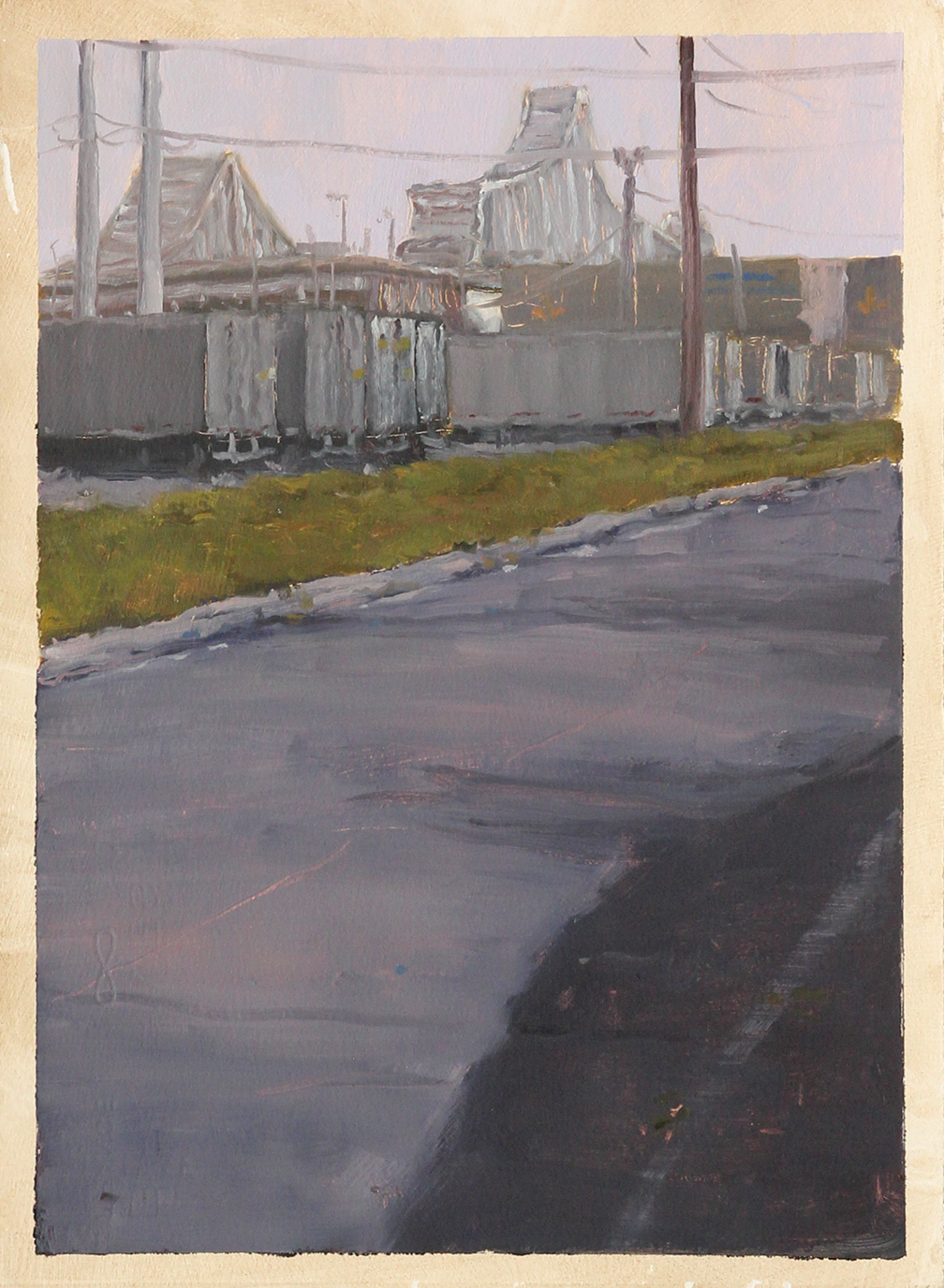
These were painted from reference photographs over the summer, with modified Zorn palette. Each piece took about 2-3 hours to finish, except for the first one that took one hour. They are about 14"x10", oil on paper. Oil paint dries through oxidation which is how rust forms. 

When I travel to less populated parts of the U.S. the use of land in those areas always fascinates me: Forests, farmlands, swamps, parking lots, and factories; Mid-sized towns with no public transportation or sidewalks; Dilapidated downtowns and suburban drive-through Starbucks; Dead cars rusting away in front yards, back alleys, and vacant lots. 


Sunday, August 11, 2019

Appetite for Destruction

Destruction proceeds the creation, or re-creation. I enjoy smudging and erasing images just to see if I can rebuild them differently. If I don't take the time to do so, the finished paintings would look odd, because they lack this certain quality that I'm after, which I can't explain in words exactly what that is. Energy? Tension? Danger? Attitude? I don't know.

It feels invigorating to completely erase a finished painting! When my paintings come out dead, I take an electric sander and sand them down to nothing. This is another reason I love painting on wooden panels.

trace of gray paint stays after sanding

The leftover paint acts as a groove and I kinda like painting on a surface that is not completely white. It also fits my subject matter of aged or abandoned structures in urban landscape.

underpainting in transparent oxide red

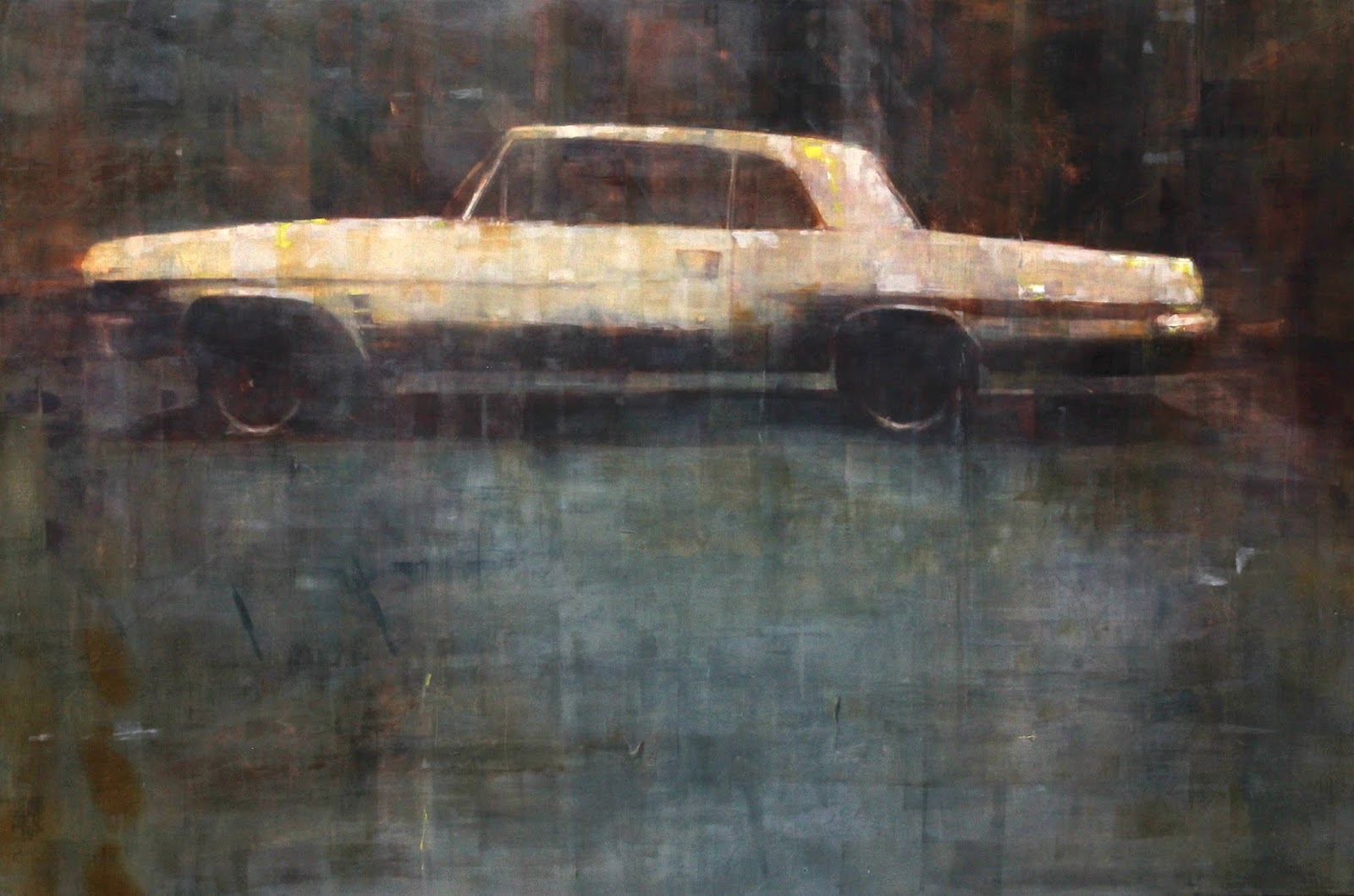
My underpainting sometimes turns out really tight. Depending on the subject matter I go back and forth between really loose and tight underpaintings. I wanted to be faithful to the form of this car but left the background less defined.

Tempest, 2018, oil on panel, 32"x48"

Painting with brayers opened up a whole new universe in front of me. When I paint plein air I still use brushes, but in the studio with larger panels, I don't even dream of using brushes.

Nowadays I stop sanding the original paintings halfway and leave ghost images.


I painted over these in a way that the ghost images showed through - they became the "under-underpantings."

By the way dried oil paint powder is toxic. Don't forget to wear a mask and goggles when sanding!

Saturday, December 15, 2018

Plein Air Painting and Cast Shadows

The biggest difference between painting on location (en plein air) and painting in studio is the time management. Although some painters (like Monet) go back to the same location multiple times to finish one painting over days and weeks, most plein air painters spend about 3 hours to finish a painting. Within those 3-hour painters, a portion of them put in finishing touches in their studios. Many develop a larger studio painting based on the smaller plein air pieces, field notes, and their memories. I've made multiple-day plein air paintings, not by choice, when I was in class and ran out of time. But I prefer to finish the damn thing on location in one sitting and move on.

Painting en plein air in winter is especially tricky though, because within 3 hours, the direction of cast shadows shifts close to 60°. You have to decide when to switch from painting what you see to painting what you remember. To me the switch usually happens midway through the 3-hour session. If I don't make the switch, I end up making a painting like this:

Hanger on Desire Street
oil on canvas, 16"x22" (2013)

The cast shadows on the ground were painted early on, and the shadows of the two rooftop chimneys were put in near the end of the same 3-hour session - duh!
This will never happen in a studio, unless you're making a surreal painting that purposely messes with perception.

The painting below was done in about 3 hours in a strong wind, while shivering and saying hello to the passersby and security guards. I was also under at least 8 security cameras.

French Quarter Alleyway
(or Askew Light Post Named Wallace)
oil on panel, 8"x12" (2018)

The red and yellow buildings in the background stayed lit in the same way the whole time, but the brick buildings on the left went from dominantly-in-shades to completely-lit by sunlight. The top of the shadows cast by the tall buildings on the right side (off the frame) was at the third floor level of the buildings on the left when I started. But within 2 hours or so, the sun moved (or I should say the earth turned) to where the top of the same cast shadow was on the sidewalk. I decided that the top of the cast shadow should be in the middle of the light-green doorway, and lined everything up accordingly.

Now the question is, what made the top of the light post askew in real life while the rest of the post stayed straight?


Tuesday, December 4, 2018

View from Maurepas

Maurepas Foods closed in October of 2015, after 3 glorious years as the neighborhood restaurant with inexpensive & innovative Southern dishes that highlighted seasonal ingredients. Their staff was always nice and friendly, a rarity in most hip establishments in Bywater (or anywhere else in the U.S.), and the decor matched the food they served as well: tastefully new and authentic at the same time. It was one of our favorite places to eat.

When I made the plein air painting below, they weren't open yet. I remember seeing boarded windows and a sign saying 'Maurepas Foods coming soon' or things of that nature. There was (and still is) a wrap-around awning that creates a nice shade where you can set up an easel and look at this view across the street in morning sun.

Koffskey Building, oil on canvas, 18"x24"
(2010 or 11)

L.E. Koffskey building used to be a pharmacy, but its current owners/residents are a photographer and a musician. I've been inside once a while back, and it was really nice since they kept the original tiled floor and most of the display cases that looked almost antique. The two-story building to the right is a yoga studio at the bottom floor, and an apartment on the second floor. 

View from Maurepas, oil on panel, 10"x20"
(November 2018)

After Maurepas Foods closed, the building behind me (which you don't see in the paintings) stays empty. The two Japanese Maple trees by the Koffskey building have grown much taller since the last time I painted them. And on this crisp fall morning they were in red and gold.


Thursday, November 29, 2018

View from the Bomb Factory

Since the weather turned tolerable, I've started painting outdoors again, usually with Phil and Claude. This past month we painted in Bywater area of New Orleans, for the eclectic mix of blight, swank, and funk. I really enjoy just being in Bywater.

One day Phil texted us soliciting ideas for the next painting location. My first answer was Japonica and N. Robertson at the edge of the Upper 9th.

one of my favorite views in the city
The studio painting above is from 2014, and 24"x36" on canvas. The bridge is the Claiborne Bridge over the Industrial Canal.  Below is from this month.

View from the Bomb Factory
oil on muslin and Gatorfoam, 12"x8"
I've been experimenting with different painting surfaces again. When I paint with others I can hitch a ride, but when I'm alone the weight of the painting gear becomes a problem rather quickly even on a short bike ride. Instead of getting into better physical fitness, my solution has always been to look for the lightest painting gear.

Gatorfoam Board had been on my radar for a while because of its light weight and warp-resistant hard surface. It's basically a foam core board sandwiched with ultra thin wooden veneers, and they are used most commonly for indoor signage. The surface is water proof and a lot of watercolorists use them as a support for stretching watercolor paper. The foam core center, which is exposed on the sides, will deteriorate when oil paint or solvent touches it. Most oil painters would adhere gessoed linen onto the board using rabbit skin glue or PVA. But I hate canvases and I can't afford linen.

Muslin is used, among other things, for diffusing lights in film production, and we had a huge roll of it in the closet. It's thinner and has a much smoother surface than canvases, and it's perfect for the light weight painting surface. View from the Bomb Factory above was the second painting I made on muslin and Gatorfoam: I really liked painting on it.

But!
It takes so much time and labor just to prepare the panels, and I'm not sure if I can continue justifying the time I'm NOT actually painting. There are pre-made panels for sale but they are so damn expensive because they use linen instead of muslin (and oil primed! highest quality!). And Gatorfoam alone ain't cheap either.

(The Bomb Factory, by the way, is across the street from this fenced area in the paintings, and they do magical restorations on classic cars and hot rods. Hi Rick!)